Blog
Posted on 2/22/2019 7:11:09 PM
By Donald Fox
2 Comments

I started writing this back in July when I took several days to visit home in North Carolina. I didn’t finish this for some reason and saved it to my desktop. This completion is just one among many incomplete projects, each of which in time will find a conclusion. The next paragraph begins the earlier draft with one possible ending to wrap up this piece with a not so tidy bow.
The past week has been spent in my home town mostly to work on clearing my late father’s house, so we can sell it. My dad was something of a hoarder, he kept meticulous records, and in his later years he surreptitiously ordered many unneeded items from numerous sources without the knowledge of my older brother, the closest living relative tasked with keeping an eye on him. One obsession was with watches. There must have been fifty watches around the house stuffed in drawers, in the closet, in bathroom cabinets, and in the kitchen. Most of them don’t work as the batteries have died. Perhaps my dad thought increasingly about time as his was growing shorter. Time was always important to him since he followed a strict schedule as an airline pilot.
The last two years Pop lived with my brother and his wife, so the house was unattended except for brief visits when my dad could piddle with some of his things as he pined for the day when he could return to living as he had, a day that would never come. After he passed last year, we managed to resolve the estate, but for some reason Pop had not made the house part of it. So now it falls on all of us to clear it out and put it on the market. As is usual in life, however, many other priorities interject themselves into each sibling family including health challenges of our own. Also, we’re spread between Massachusetts, Texas, and North Carolina, which makes coordinating time together quite difficult. My older brother, being the closest, has borne the brunt of it with some help from his wife and a daughter. They have managed to clear the attic and dispose of some things, but there still is much remaining. We now at least have a plan, and I managed to sort through a lot of old records this week including years of checks and stubs that went back to 1948 (the year my wife was born).
I told my brother that going through these records was like being on an archaeological adventure. The process certainly brought up many memories, but most interesting for me was seeing my parents’ financial records from all those years, particularly the ones I could match in memory with events I lived through. There is revelation of the struggles they faced, some financial challenges, but mostly they persevered through determined steady progress and their financial discipline. I know now why I was told many things as a child, plus my adult perspective has taught me that the discipline I learned from them has meant more than I realized at any given moment. I thank them for their lessons although at times they seemed overly harsh. This reminds me of when I once told a friend about much of the physical work my brother and I did for many years as children (part of my dad’s disciplinary lessons, not as punishment but simply passing on what he did when he was a child growing up on a small farm in a large family) – my friend said that my childhood sounded very Spartan. His by contrast was carefree and idyllic. We experienced much of that too. We certainly had a lot of freedom of movement throughout several adjacent neighborhoods and knew a lot of kids with whom we had all kinds of adventures. There were times, though, when we had our yardwork to do within sight of other kids playing ball across the street in the large open field that eventually was occupied by a local church.
As with all things, time has changed the physical state of that neighborhood, but the memories linger. Along with them are certain contrasting emotions and habits that carry on: the desire for carefree activity and actions that grow from long-standing discipline. Think of this as conflict between romanticism and realism, the ideal versus the mundane. Perhaps my pursuit of art has been a path for combining the pull of the imaginative, the playful, and dreamy with the discipline of work, commitment, and engagement. Someone did once say that art is ten percent inspiration and ninety percent perspiration.
Posted on 2/17/2019 1:33:56 PM
By Donald Fox
Comment on this

Open to It
Sometimes, while visiting a museum, but less frequently experienced in art galleries, I may have a series of sensations throughout my body while encountering a particular work of art. These sensations are not localized in my eyes, my vision, or simply within my mind as might be assumed where the art experience would originate. Rather, the experience is whole body like a rush of energy that fills me top to bottom, inside to outside, tingling and warmth mingled with a deep “aha,” which itself is not so much an intellectual realization or understanding as it is a sense of rightness, of wholeness, of recognition of unique presence that is either something never encountered before or some combination of familiar things juxtaposed in such a way that a completely new idea-object-phenomenon is there manifested before me. I am instantly transported to a unique space-time wherein the outside world has no influence. It is me, the object before me, and the experience we create together in a moment that has no chronological counterpart. We exist in a realm that I would call the artistic experience that may make sense to others as being like that rare instance of perceiving an exotic natural phenomenon for the first time or engaging in sex with a beloved partner. How do you define such an experience, or do you simply enjoy it, merge with it, and embrace it with all your being?
The act of painting similarly emerges from activity blended with emotion and feeling and thought. There is no clock time limitation, for the experience may last a few minutes, a few hours, a few days, or weeks or months or years. It is being and doing and expressing that can be work-play or play-work but does not fit, at least for me, within the social scheme of what is considered required activity of the responsible adult to be a contributing member of society. And yet, what comes out of the activity is something that enhances the social order in the most profound ways. Painting is a calling that many are dedicated to in spite of obstacles often thrown in their path.
Any member of that society can find him or herself transformed by an art encounter without the expectation that such will occur. It can be serendipitous, but it can also be sought out, and anyone could prime him or herself for repeated exposure on a regular basis. Artistic mindset is not relegated only to artists. Anyone can be inquisitive, curious, attentive, engaged, sensitive, awestruck, humbled, and receptive. Openness is a choice. Looking is a choice. Thinking is a choice. Learning is a choice, and art allows us opportunities to experience and re-experience in the most positive ways.
Posted on 2/7/2019 10:34:38 PM
By Donald Fox
Comment on this
Two of the greatest Renaissance sculptures were created by the same artist, Benvenuto Cellini. Perhaps less famous (if fame is any gage) than Michelangelo’s David, Cellini’s Perseus with the Head of Medusa in my opinion rivals any sculptural work done before or after. The over-life size figure of the mythical hero is cast in bronze, a medium used mainly for portrait busts and outdoor commemorative monuments. What is interesting about this and the second Cellini piece is their dramatic difference in scale.
Cellini was trained as a metal worker and had created many medals, clasps, and other ornamental pieces, mostly in gold, for a range of wealthy and influential clients including the Pope. Unfortunately, many of these no longer exist having been melted down for their precious metal. In 1543, though, he completed a salt cellar for Francis I of France. Often reproduced in art history books, this roughly ten-inch-tall by thirteen-inch-long sculpted work in ivory, gold, and enamel has monumental impact especially if seen with no context for comparative scale. The exquisitely detailed reclining figures of Neptune on one side and Terra (Earth goddess) on the other can easily be read as life-size figures. Close to Terra is a miniature building atop which is another female nude figure about one-fifth the size of Terra. This much smaller figure teases a viewer’s brain to interpret the god figures as life size. This small sculpture intended to occupy an ornate dinner table belies its diminutive scale with monumental presence.
The Perseus sculpture, though not as large as Michelangelo’s David, is equally as powerful a portrayal of the idealized human figure, this one having just completed beheading the hideous creature Medusa. The statue is placed in the Loggia dei Lanzi of the Piazza della Signoria in Florence. It directly faces Michelangelo’s sculpture and Perseus raises the severed head of Medusa almost like a challenge to the marble figure of David as if Medusa’s one final curse turned the shepherd boy to stone.
Scale in art has been important for centuries as many pieces, sculptures and paintings, were created to adorn architectural spaces. Twentieth century artists often used large scale to make large statements expressing the idea that large size equates to more powerful work. There have been exceptions, of course (Joseph Cornell’s intimate box sculptures come readily to mind as well as the small-scale Homage to the Square series of Joseph Albers), but most emphasis in much modern painting has pushed way beyond easel painting. An artistic challenge still worth taking on is making a small piece seem monumental like Cellini did with the salt cellar. The perspective of the viewer is an important part of this process for it is in the viewer’s experience that scale, large or small, takes on experiential meaning. A seventeenth century Dutch easel painting of a cathedral interior, for example, can stimulate a viewer’s imagination to the vast expanse of such an interior.
In this day and age when images are often reduced to smaller and smaller screens, it is important that we exercise perception of both large and small to not lose ourselves in a convoluted world of diminutive thoughts and ideas.
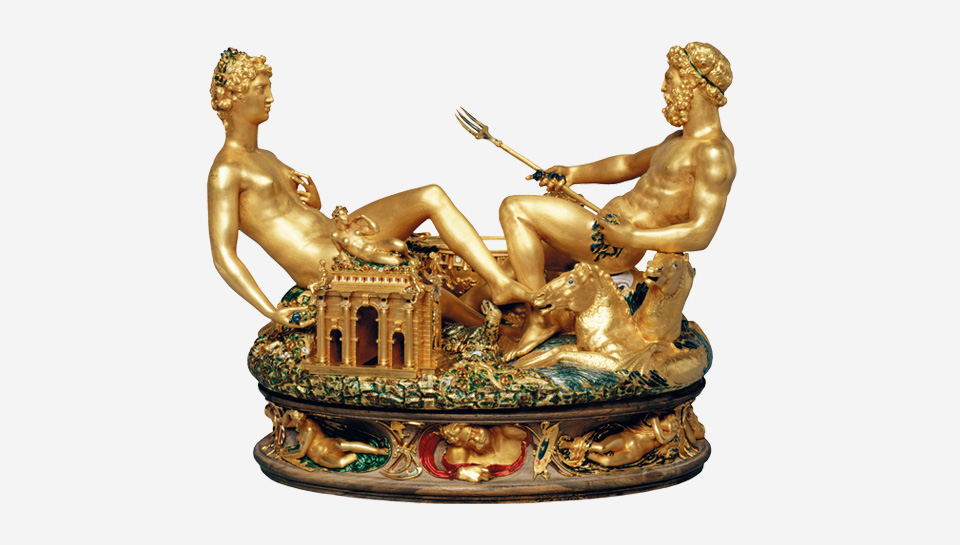
Benvenuto Cellini Salt Cellar 1543
Posted on 2/1/2019 7:53:11 PM
By Donald Fox
Comment on this
A new painting completed today and posted on my website. I don’t want to say much about it although there are many thoughts behind it. Earlier today I was thinking about Dylan Thomas, one of my favorite poets for many decades, whose work always reminds me of color and texture and how thoroughly infused we are with the natural world. I was also thinking about the work of Swiss painter Paul Klee, mostly playful but sometimes moody. My painting is not about either of these artists or their work though it may echo in some manner a certain shared sense of being. But really, all paintings I make reflect on some level everything I’ve ever encountered. How could they not?

Interlaced oil on canvas 40" x 30"
